 Bird Supplies
 Bird Accessories
 Bird Cages & Carriers
 Bird Feeders
 Bird Nests & Beds
 Bird Toys
 Feeding Supplies
 Automatic Feeders
 Feeding Mats
 Pet Bowls
 Slow Feed Bowls
 Water Dispensers
 Grooming & Care
 Cleaning Tools
 Grooming Gloves
 Nail Clippers
 Pet Brushes
 Other
Other Pet Accessories
 Harnesses
 Leashes
 Tags
Tags Pet Apparel
 Cat Apparel
 Pet Costumes
 Pet Diapers
 Pet Life Jackets
 Pet Homes & Crates
 Cat Trees & Scratching Furniture
 Dog Crates
 Indoor Pet Houses
 Pet Beds & Houses
 Pet Carriers
 Small Pet Habitats
 Pet Toys
 Cat Toys
 Dog Toys
 Interactive Toys
 Plush Toys
 Reptile Supplies
 Reptile Accessories
 Reptile Feeders & Bowls
 Reptile Habitats & Terrariums
 Reptile Heating & Lighting
 Reptile Hideouts & Decor
 Reptile Humidity & Climate
 Portable Water Bottles
 Travel Bags
Dog Crate Size Guide: How to Choose the Right Crate for Puppies, Adult Dogs, and Home Use
Dog Crate Size Guide: How to Choose the Right Crate for Puppies, Adult Dogs, and Home Use
The right dog crate size is big enough for your dog to stand up without crouching, turn around comfortably, and lie down fully stretched, but not so oversized that it works against crate-training goals. For most dogs, the simplest formula is to measure nose-to-base-of-tail length and standing height, then add about 2 to 4 inches of extra room in each direction.
If you are wondering what size crate does my dog need, start with your dog’s real measurements instead of guessing by breed alone. Puppies usually need a crate with room to grow plus a crate divider, while adult dogs need a size that matches how they actually rest at home, travel, and settle overnight.
Quick Answer: How to Size a Dog Crate
Use this quick formula before you buy:
- Crate length: your dog’s body length (nose to base of tail) + 2 to 4 inches
- Crate height: your dog’s standing height (floor to top of head or ears, whichever is taller) + 2 to 4 inches
- Crate width: enough for your dog to turn around without squeezing shoulders or hips
A crate that is too small feels restrictive and uncomfortable. A crate that is too big can make house-training harder, especially for puppies, because it gives them room to sleep in one area and eliminate in another.
Summary takeaway
A properly sized dog crate should feel like a comfortable den, not a storage box and not a tiny bedroom. If your dog cannot stand, turn, and lie down easily, size up. If you are crate training a puppy, choose a crate that fits adult size and use a crate divider until the puppy grows into it.
Dog Crate Size Checklist
Before comparing crate models, check these basics:
- measure your dog instead of relying only on breed charts
- think about whether the crate is for sleeping, daytime downtime, car travel, or multi-purpose home use
- account for thick bedding that reduces interior room
- check door placement if your space is tight at home
- use a divider for puppies instead of buying multiple crates too quickly
- do not choose a much larger crate just because your dog “might like extra room”
How to Measure Length and Height Correctly
When people ask how to size a dog crate, the biggest mistake is measuring loosely or using the dog’s weight alone. Weight helps narrow the range, but body shape matters just as much.
Measure body length the practical way
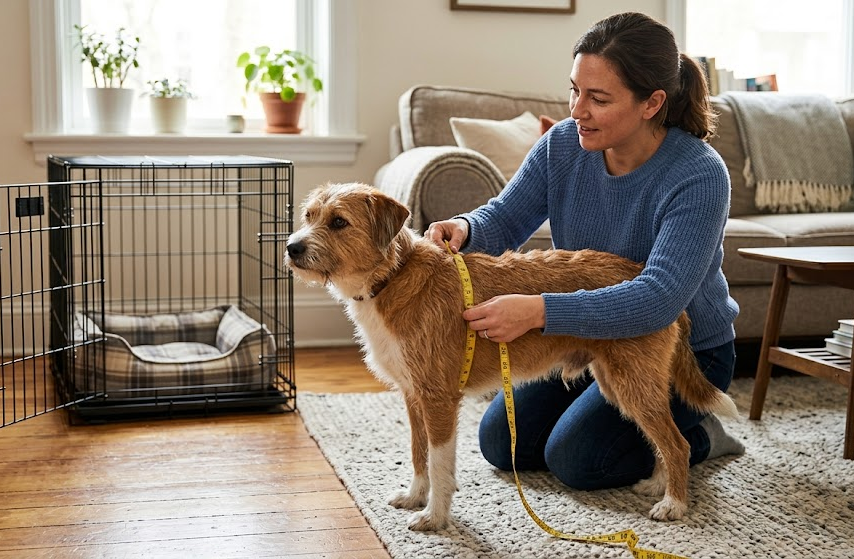
Have your dog stand naturally. Measure from the tip of the nose to the base of the tail, not to the tail tip. Tail length does not tell you how much usable floor space your dog needs inside the crate.
If your dog falls between sizes, look at how they sleep. Dogs that curl up tightly can sometimes fit a little more easily into a shorter crate than dogs that like to stretch long on their side.
Measure standing height the practical way
Measure from the floor to the top of the head or the ear tips, whichever is taller when your dog is standing alert. Then add a little extra room so your dog does not need to duck while entering or standing inside.
A useful rule is simple: if your dog looks like they need to hunch, the crate is too short.
Why breed charts are only a starting point
Breed examples can help, but they are not precise enough on their own. Two dogs of the same breed can have very different chest depth, leg length, or body condition. That is why dog crate sizes should always be confirmed with real measurements.
Puppy Crate Sizing and When to Use a Divider
A puppy does not need a giant crate just because they will eventually grow into one. What they need is the right usable space for their current stage.
That is where a crate divider helps. You can buy a crate sized for your dog’s expected adult measurements, then reduce the usable interior space while your puppy is still small. As your puppy grows, move the divider gradually.
Why a divider matters
For crate training, too much unused room can slow progress. Many puppies are less likely to keep the crate clean when they can sleep at one end and use the other end as a bathroom zone. A divider keeps the crate appropriately sized without forcing you to replace the whole setup every few months.
Should you size up for a puppy?
Yes, but only with control. The better answer is not “buy the biggest crate you can find.” The better answer is “buy the adult-size crate you are likely to need and use the divider correctly now.”
This approach usually saves money, keeps training more consistent, and gives you a more practical long-term setup for home use.
Signs a Crate Is Too Small or Too Big
Crate fit problems are usually obvious once you know what to watch for.
Signs the crate is too small
- your dog cannot stand without lowering the head or ears awkwardly
- your dog cannot turn around in one smooth movement
- your dog lies down only in a cramped or tucked position
- your dog keeps pressing against the sides because there is not enough width
- entering and exiting the crate looks awkward or hesitant
Signs the crate is too big
- a puppy regularly uses one side as a toilet area
- the crate feels cavernous compared with your dog’s body size
- your dog drifts around the crate instead of settling into one resting zone
- bedding, bowls, and accessories leave too much open space for training use
A larger crate is not automatically kinder. For adult dog comfort, some extra room is good. For training, too much empty space can work against the point of the crate.
Common Dog Crate Sizes and Who They Usually Fit
Manufacturers vary, but most crate lines follow a broadly similar pattern. Use this as a rough orientation only, then confirm with your own measurement results.
| Common crate label | Approximate length | Often used for |
|---|---|---|
| Small | 24 inches | toy breeds, very small dogs, short-term puppy stages |
| Medium | 30 inches | many small-to-medium adult dogs |
| Intermediate | 36 inches | medium dogs or growing puppies expected to be medium-large adults |
| Large | 42 inches | many large breeds with moderate build |
| Extra large | 48 inches | very large breeds or dogs with long body length |
This table is not a substitute for measuring. A lean, long dog may need a longer crate than a heavier but shorter dog of the same weight.
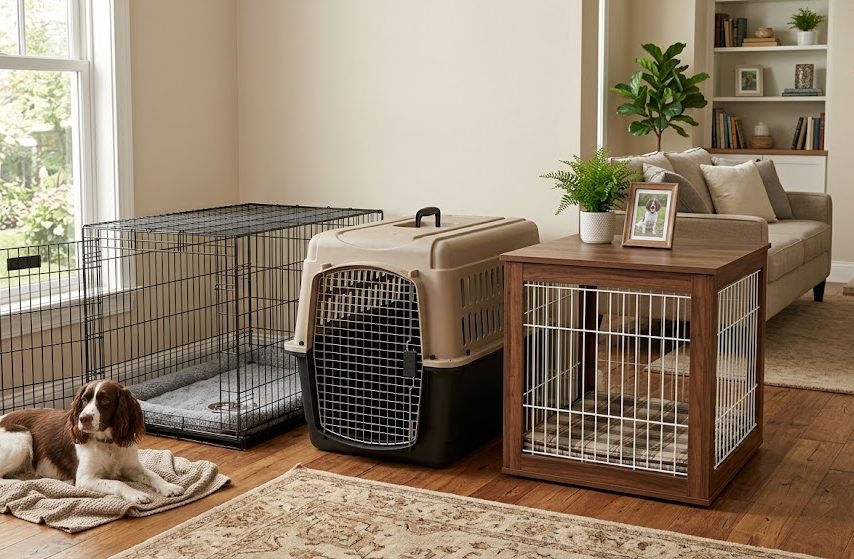
Home-Use Crate Types: Wire, Plastic, Furniture, and Travel Crates
The right size is not the only decision. The crate type changes how that size works in daily life.
Wire crates
Wire crates are common for home use because they offer airflow, visibility, and easy divider compatibility. They are often the easiest option when you want one crate for puppy training and adult use.
Best for:
- home crate training
- dogs that run warm
- owners who want flexible divider setup
- people who may fold or move the crate occasionally
Plastic crates
Plastic crates feel more enclosed and are often preferred for dogs that settle better with less visual stimulation. They can also work well for travel, depending on the design.
Best for:
- dogs that do better in a more den-like space
- owners who want a more enclosed sleeping setup
- certain travel use cases where rigid structure matters
Furniture-style crates
A dog crate furniture setup can blend into the home more naturally, but sizing mistakes are more expensive here because aesthetics sometimes tempt buyers to prioritize exterior style over usable interior space.
Best for:
- owners who want the crate to live in a main room long-term
- homes where appearance matters almost as much as function
Be careful: always check interior dimensions, not just outer dimensions.
Travel crates and car crates
A dog crate for car use has extra constraints. Vehicle cargo space, door swing, and safety setup all matter. A crate that is perfect in the living room may be wrong for your vehicle.
If car use is part of the plan, measure your vehicle space separately before buying.
Crate Accessories That Affect Fit and Comfort
Accessories can quietly change whether a crate feels right.
Bedding
A thick bed or raised pad reduces usable interior height and width. If you plan to use plush bedding, do not measure for the bare crate only.
Divider panels
A divider is not just a puppy accessory. It is part of the actual fit strategy for any growing dog.
Bowls and mounted accessories
Hanging bowls, clip-on storage, and bulky toys take up room. In a crate that is already borderline small, those extras can make the fit noticeably worse.
Covers
A crate cover can help some dogs relax, but it does not fix a size problem. If the crate is cramped, covering it will not make it more comfortable.
How to Choose the Right Crate for Puppies, Adult Dogs, and Daily Home Use
For puppies
Choose based on expected adult size, then use a divider. Prioritize adjustability and easy cleaning over oversized space.
For adult dogs
Choose the crate that matches your dog’s real standing height, body length, and resting style. Adult dogs often do best when the crate feels comfortably fitted rather than oversized.
For multi-purpose home use
If the crate will be part sleeping space, part training tool, and part quiet retreat, a wire crate with a divider is often the most flexible choice. If your dog prefers a more enclosed environment, a well-sized plastic crate can work better.
FAQ
How do I know if my dog’s crate is too small?
If your dog cannot stand comfortably, turn around easily, or lie down without curling unnaturally, the crate is too small.
Should I size up a crate for a puppy?
Yes, but use a divider. Buy for expected adult size and adjust the usable space while your puppy is growing.
Do I need a crate divider?
If you are crate training a growing puppy, usually yes. A divider helps keep the space appropriate without buying several crates in rapid succession.
What type of crate is best for home use?
For many households, a wire crate is the most flexible for home use because it works well with dividers, offers ventilation, and is easy to size across puppy and adult stages. Some dogs, though, settle better in a plastic crate.
Final Verdict
If you want the shortest answer to what size crate does my dog need, measure your dog, add a few inches for comfort, and avoid the temptation to oversize the crate too much. For puppies, the smartest move is usually an adult-size crate plus a divider. For adult dogs, comfort comes from the right fit, not the biggest footprint.
Get the measurements right first, then choose the crate style that fits your home routine. That order usually leads to a better setup than shopping by breed guesswork or product photos alone.